During one of my miserable fundraising attempts in 2022-2023, already 7-8 years into building Unum, I showed a slide like this to a bunch of investors, saying that Unum was aiming to become “The World’s Smallest Big Tech Company.”
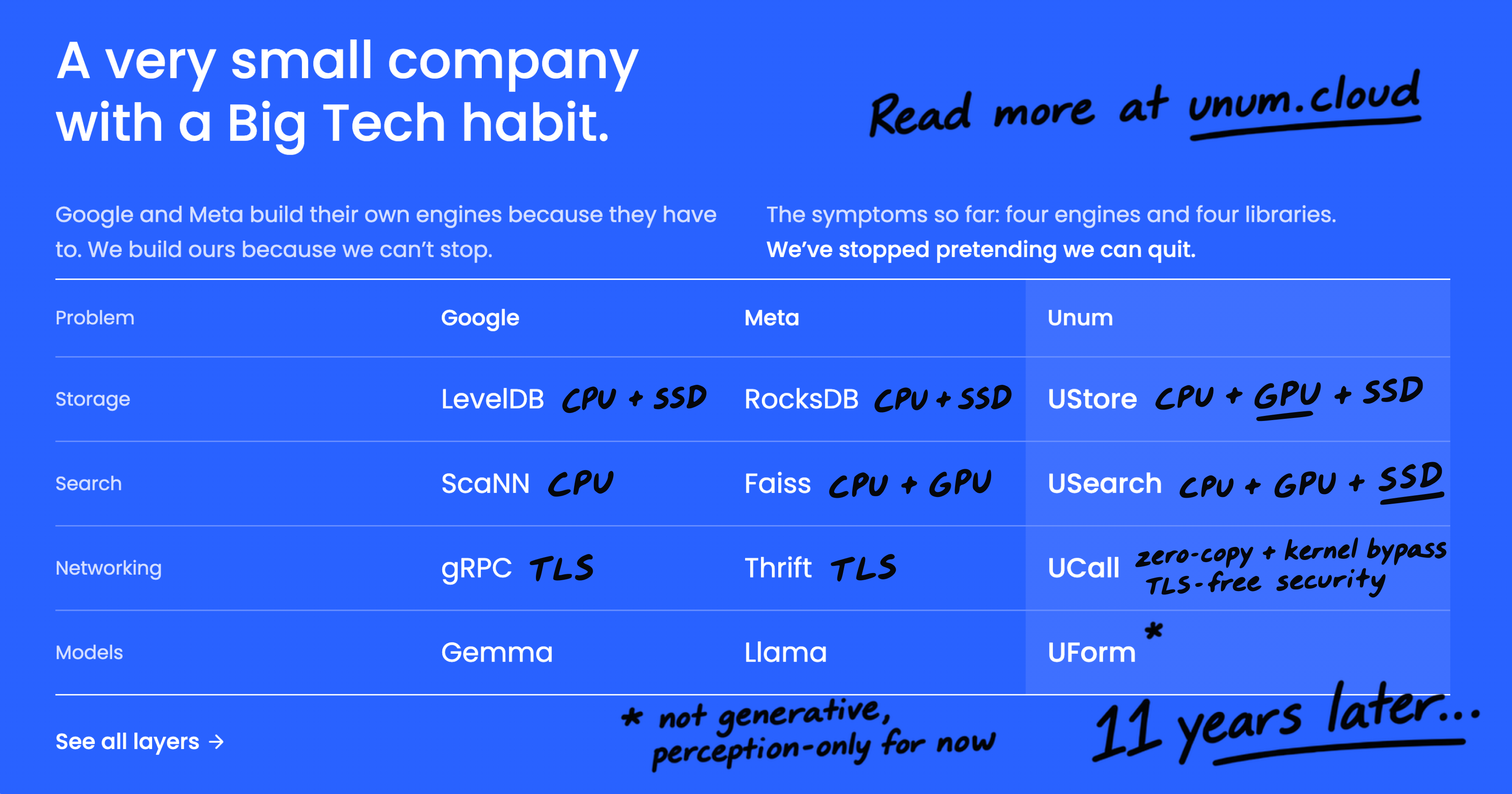
Google’s and Meta’s engines next to ours: LevelDB and RocksDB against UStore, ScaNN and FAISS against USearch, gRPC and Thrift against UCall.
It started as a joke, became an aspiration for me, and seemed completely delusional to everyone else…
Few people appreciate how much of the YC and broader Silicon Valley startup ecosystem is built on infrastructure open-sourced by Google and Meta, much of it designed around the hardware and workloads of the 2000s and 2010s. What excites me about revisiting this slide isn’t just that we’re outperforming their engines in many relevant workloads, but that we get to architecturally reimagine them for a different era of computing.
This month I published the release candidates for the new UStore, USearch, UCall, and UForm on their main branches. With these releases, I want to articulate a vision of how modern infrastructure engines should work — where computational primitives end, where engines begin, and where higher-level solutions belong.
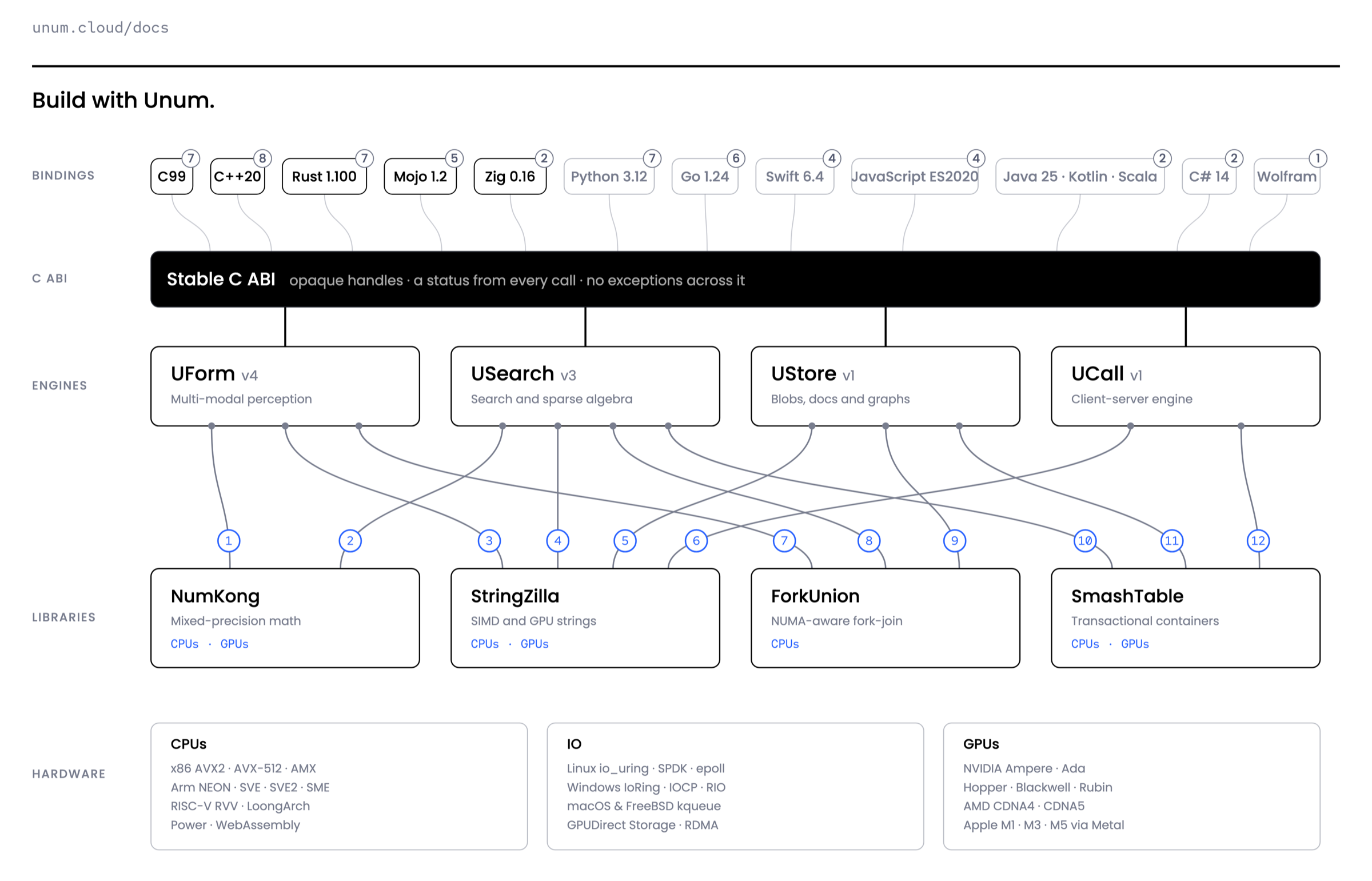
Bindings, one stable C ABI, four engines, and the four libraries beneath them: NumKong, StringZilla, ForkUnion, and SmashTable. The interactive version lives in the Unum docs.
Together, they are the closest I’ve come to building infrastructure the way I’ve always wanted to. For perhaps the first time in over 20 years of writing code, I feel like I haven’t held anything back, and I genuinely enjoy looking at the result!
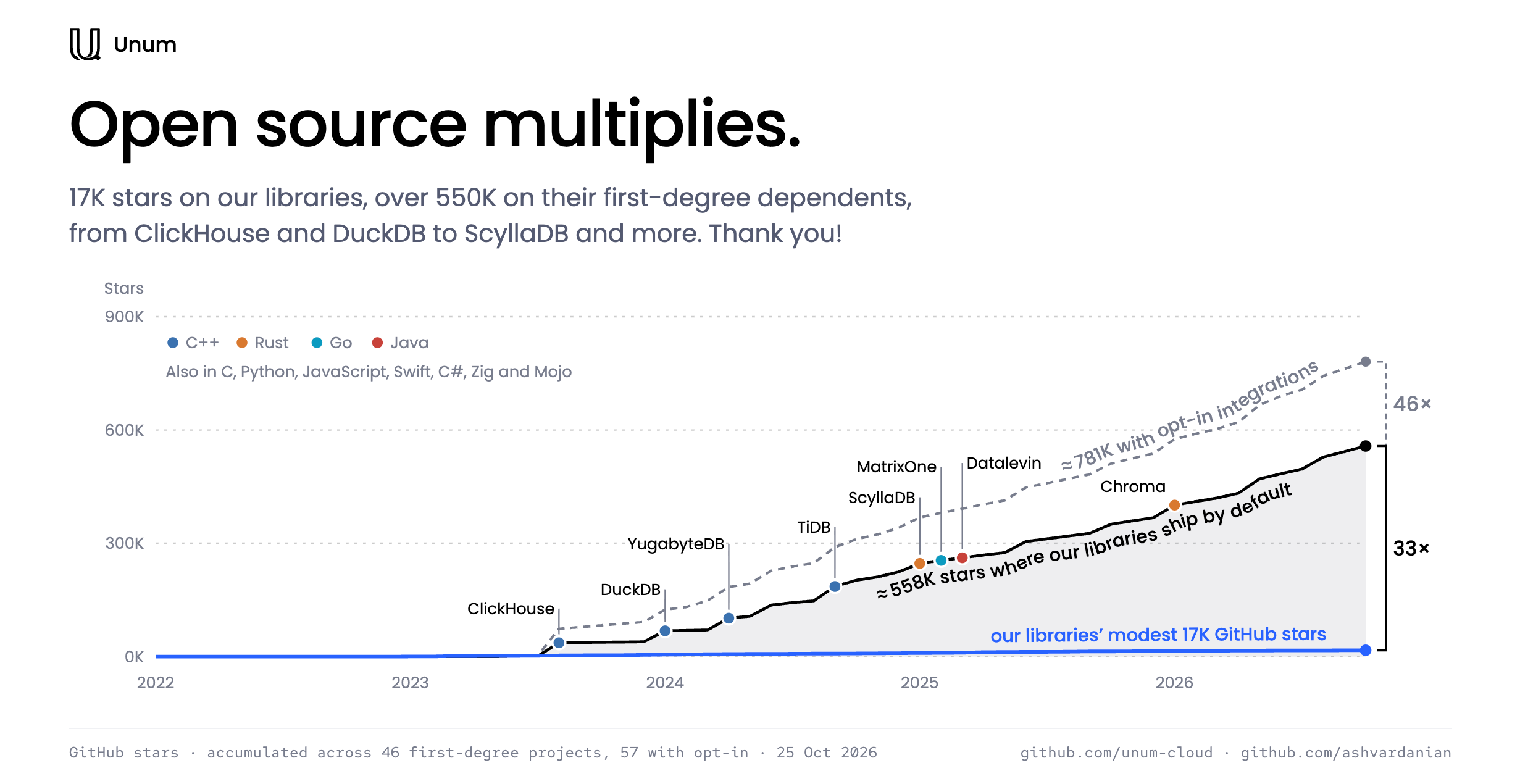
Meanwhile, my repositories have reached modest ~17K GitHub stars, but underpin a more substantial ~0.5M stars’ worth of downstream open-source and run on hundreds of millions of devices worldwide.
For the past two years, hardly a week has gone by without someone asking whether I’m finally ready to (re)incorporate, commercialize, or join one of the NeoLabs…
Finding a sustainable way to support good work matters enormously, but so does preserving the freedom to do it. I took my time, hustled my way back to basic financial stability, and turned down some extraordinary opportunities that I’m still grateful for.
Looking back, I’m glad my attempt to build a Palantir-like company with a walled-garden approach didn’t work out. What a shame it would have been to keep all this beauty behind a paywall!
Google and Meta largely built their infrastructure to support their own products. I get to build mine for people whose products I may not even be able to imagine yet.
There is no number of billions I’d trade for the privilege of seeing my work empower others to design drugs, automate robots, personalize education, and hopefully, one day — change the way we approach policymaking.
For those who know me personally and have endured enough of my overly animated discussions about technology and its place in the world, fueled by ~2L of coffee a day, I suspect my eventual descent into open-source was inevitable 😅
Unum turns 11 today! With at least 29 years of my original 40-year vision still ahead, I’m arguably just getting started… I have all of you to thank — for challenging my ideas, trusting me, building on top of my work, and spreading the word!